(re)Boot Sales Camp
The whole playbook. One room. No passengers.
How Today Works
1The exam told us WHAT
Your section scores are a diagnosis, not a grade. Under 80% in a section means that chapter gets extra time today.
2This deck is the review
Eight chapters, same map as the exam. We move fast through what the room knows and slow down where the data says to.
3You leave with a contract
Your H2 reforecast and three SMART actions are already signed. Camp is where they become real.
Nobody gets credit today for knowing. Execution is the receipt.
Everything Serves Three Beliefs
1"I have a problem."
Built during Project Goals and Show Findings. If they don't believe this, nothing else matters.
2"It needs to be fixed NOW."
Built through Trend and Urgency. Physics doesn't wait, and neither should they.
3"GL Hunt is the company."
Built through professionalism, credentials, and truth-telling. Nearly 40 years. Over 7,000 five-star reviews.
We fall, every single time,
to the level of our standards.
Standards Are What You Tolerate
- Not what you preach. Not what's in the handbook. Not what gets said in meetings.
- What you walk past, what you laugh off, what you explain away: that's the real standard.
- Every time you let something slide, you didn't "give grace." You quietly rewrote the rules.
High Standards Are Quiet
Low standards
Need reminders. Need speeches. Need someone watching. Feel flexible, produce chaos.
High standards
Show up on time. Prepare. Finish. Follow through when no one is watching. They need reps, not reminders.
You don't get credit
for knowing the standard.
Execution is the receipt. You're judged by what you consistently do.
Standards Cost Something,
Or They're Fake
- High standards cost comfort. They cost popularity. Sometimes they cost people.
- If your standards never cost you anything, they aren't standards. They're preferences.
- Bad days don't lower the bar. They reveal whether the bar was real in the first place.
Work the Room
What have we been walking past? Name one thing this team tolerates on appointments that we stop tolerating this half. Write it down. It just became a standard.
Winging it
doesn't scale.
The Mindset Triangle
BELIEF
"I will win this appointment." "This customer needs my help." "Today is the right day to fix this." "I am a professional, not a contractor."
BEHAVIOR
The actions you take in the appointment. Behaviors are downstream of beliefs. You cannot out-script a belief problem.
RESULTS
Close rate, average ticket, cancellations. Results are downstream of behaviors. Fix the top of the triangle first.
The Two Halves
First half: Seek to Understand
Introduction · Meeting Plan · Project Goals · Inspection
You are a detective, not a presenter. Their problem, their fears, their timeline, their decision process: in their words.
Second half: Seek to Be Understood
Show Findings · Present Solutions · Scope Project · Ask for Business
You are a guide, not a salesperson. What you found, what it means, why GL Hunt.
The Appointment Arc · 8 Stages
| # | Stage | Time | Key actions |
|---|---|---|---|
| 1 | Introduction | 2-3 min | Greet, let them show you, Affirmation Statement |
| 2 | Meeting Plan | 2-3 min | How you'll use their time, set expectations |
| 3 | Project Goals | 10-15 min | Interview, capture goals, find the Customer Why |
| 4 | Inspection | 20-30 min | Measurements, 10+ photos, document evidence |
| 5 | Show Findings | 15-20 min | Walk to damage, demonstrate with tools |
| 6 | Present Solutions | 10-15 min | Credentials, cause, solution, connect to goals |
| 7 | Scope Project | 5-10 min | Confirm proposal, expectations, timeline |
| 8 | Ask for Business | 5-10 min | Price with paths, same-day savings, THE ASK |
Scripts Are Studs and Beams
Your humanity, your personality: that's the wallboard, the paint, the decorations that make the building come to life.
Master the structure first. Then make it your own.
Project Goals Is Your Objection Radar
| Ask this | It surfaces |
|---|---|
| "Besides yourself, who else is involved in this decision?" | The one-legger, before it ambushes your close |
| "Why do you want to fix it now?" | "Just trying to understand" / "Selling in a year" |
| "How long have you been thinking about fixing this?" | "I need to think about it" |
| "Payment plans, or have you already budgeted?" | "It's too expensive," and which path to lead with |
| "Other professional advice? Why didn't they fix it?" | "Getting more bids," and what actually matters to them |
The iPad is the map,
not the tour.
Every Show Findings: 4 Steps, 3 Questions
1Lead Need
Start with why they called. It's what they're expecting.
2Trend
At least 3 supporting evidence points. One data point is an opinion; three are a pattern.
3Urgency
Connect the trend to consequences. What happens if they do nothing?
4Action
Convert the finding into a goal. Get verbal commitment before going back inside.
"What is this evidence showing us?"
They interpret it, they own it. Ownership bias.
"What happens if you do nothing?"
Future pain, in their words. Loss aversion: 2x stronger than gain.
"If that happens, how would you feel?"
Emotional lock-in. Logic tells. Emotion sells.
The Close: 4 Steps, In Order, Every Time
| 1 · Recap the goals | "You wanted to [Goal 1], [Goal 2], [Goal 3] because [Why]. Did I miss anything?" |
| 2 · Price WITH paths | Never price alone: Cash/ACH saves 10% · Upgrade financing · Pay-at-Close from escrow |
| 3 · Same-day savings | Earned by deciding today (additional 5%), never begged. "When will you be making a decision?" |
| 4 · THE ASK | "Can we earn your business today?" Then STOP TALKING. |
No Weak Streams
Weak stream
"What do you think?"
"Let me know if you have questions."
"I can probably get you a discount..."
"Take your time to think about it."
Strong stream
"Can we earn your business today?"
"What questions can I answer before we get started?"
"Here's how you save 10% if you're ready today."
"What will you be weighing tonight?"
Customers don't need
a new friend.
The Ladder: Built In Order
The Rapport Trap
- 20 minutes on the dog, the kids, the vacation, then a rushed Show Findings because time ran out.
- Avoiding hard truths so you don't "scare them." Soft-pedaling severity to protect the vibe.
- Apologetic pricing, pre-emptive discounts, no direct ask because it feels "too salesy."
- Leaving with a "maybe" that feels good until they ghost you or sign with a competitor.
The 90-Second Rule
0:00 - 1:30
Greet warmly by name. Hand them your card. Thank them. Ask to see what they called about. Full attention.
By 5:00
Meeting Plan delivered. You're in the process. Small talk they start is fine; don't extend it, don't chase it.
The redirect
"I'd love to hear more about that. Let's talk after I've had a look, I want to give your home the attention it deserves."
Friend First vs. Professional
| "Friend first" | Professional |
|---|---|
| Extended small talk before business | Acknowledges warmly, moves purposefully to the Meeting Plan |
| Avoids difficult truths to keep the vibe | Tells the truth with compassion, because that's the job |
| Presents price apologetically, braced for rejection | Presents price as the investment required to hit their goals |
| "What do you think?" and hope | "Can we earn your business today?" and waits for an answer |
| Blames tire kickers when deals die | Examines what they could have done better |
The Paradox
They say: "GL Hunt. They were professional, they showed me exactly what was wrong, and they fixed it right. Here's the number."
Customers don't refer friends. They refer professionals who solved the problem.
Be honest with yourself: which rung do YOU stall on? Rapport-camper, credibility-skipper, or trust-builder who won't ask? Say it out loud. Your partner already knows.
Objections don't appear
at the close. They reveal
themselves there.
Five Forces In Their Head
Loss Aversion
Fear of a wrong decision is 2x stronger than the pull of a right one. Doing nothing feels safe.
Status Quo Bias
"We've lived with it this long." The current mess feels safer than change.
Decision Fatigue
Too many options and data points, and "not now" becomes the escape hatch.
Social Proof Seeking
"Getting more bids" is often a search for validation, not a search for price.
Commitment Anxiety
A contract feels permanent. They want control of a decision that feels bigger than expected.
Your job
Not to overcome these with pressure. To address them proactively, through the process, so they never become objections.
#1 · "I need to think about it"
- What it really is: a socially acceptable exit. They don't believe the problem, don't believe us, or have an unvoiced concern (usually price or a missing decision-maker).
- Prevent: "How long have you been thinking about fixing this?" Months? "What's kept you from moving forward?" And before price: "Is there anything that would make this an automatic no today?"
#2 · "My spouse isn't here"
- The math: a one-legger drops your close rate by about 60%. This objection is prevented in the Meeting Plan or not at all.
- Prevent: "Besides yourself, who else will be involved?" Then: "Could we get them on a quick call during our time together? It saves everyone a second appointment."
#3 · "We're getting other bids"
- What it really is: they don't yet trust the price is fair, or they're building leverage. Social proof seeking.
- Prevent during credentials: "You'll probably talk to other companies. Ask them three things: how long in business, what the warranty actually covers, and who's there in 10 years. We're at nearly 40 and not going anywhere."
#4 · "Just trying to understand"
- The gap: they haven't decided they have a problem worth solving. This is a Show Findings problem, and if you hear it at the close, Show Findings failed.
- Prevent: "What about this problem concerns you most?" "What damage has it caused?" Then walk them to every piece of evidence. Don't rush. Don't present from the iPad.
#5 · "We're selling in a year"
The disclosure reality
Foundation problems must be legally disclosed. There is no quiet exit from this repair.
The buyer math
Buyers walk, or they negotiate $20K+ off for a $12K repair. The problem costs more unsolved than solved.
The flip
Fix it now and the transferable warranty becomes a selling point. List the home as SOLVED, not problematic.
#6 · "It's too expensive"
- It's never just price. It's a value gap (urgency wasn't built), cash flow (financing wasn't presented well), or an anchor (someone else's number in their head).
- First diagnostic: "Do you mean the total cost, or is it more about the monthly payment?" The answer picks your next conversation.
- Financing is a closing tool, not a last resort. "Most of our clients choose one of three paths," never "we have financing if you need it."
Objection Radar: One Table To Keep
| Interview question | Surfaces |
|---|---|
| "Besides yourself, who else is involved in this decision?" | One-legger |
| "Other professional advice? Why didn't they fix it?" | More bids / price sensitivity |
| "Why do you want to fix it now?" | Just understanding / selling in a year |
| "Payment plans, or already budgeted?" | Too expensive / financing resistance |
| "How long have you been thinking about fixing this?" | Need to think about it |
Partner throws you one of the six. You respond with the playbook line, not your improv. Swap. The reps matter more than the recall.
You sell what the crew
has to build.
The Pier Menu
| System | Method | Best fit / watch out |
|---|---|---|
| Concrete | Cylinders pressed to refusal or max depth | Cost-effective, strong in clay. Friction limits depth in very sandy soil. |
| Steel · 20 ft | Hydraulic pressed pipe to 20 ft | More affordable steel. May not reach load-bearing soil everywhere: check conditions. |
| Steel · 30 ft | Hydraulic pressed pipe to 30 ft | Max penetration, variable soils, long-term stability. Costs more. |
| Hybrid · 5 ft | 5 ft steel, then concrete cylinders | Steel strength where it matters, concrete economics below. |
| Hybrid · 10 ft | 10 ft steel, then concrete cylinders | The stronger hybrid for deeper problem soils. |
The Depth Log Sells Expectations
The amateur move
Quote Steel-20 and hope. Or auto-quote Steel-30 and lose on price. Either way, the number did your thinking.
The professional move
Steel-20 can absolutely fit. But 21 is an AVERAGE: refusal may come at 15 or at 26. So you say it out loud: past the 20-foot line there's a per-foot charge, and here's how that works.
Add-Ons: Know The Fine Print
| Service | Standard | Warranty |
|---|---|---|
| Exterior breakout | 3' x 3' penetration, slabs 4"-6", thicker = change order | 6 months on patches |
| Interior breakout | Same, plus prep/protection. Excludes flooring replacement and post-construction cleaning | 6 months on patches |
| Object breakout | Reposition rocks/gravel/pavers; no sand or base material replacement | 4"-6" slabs only |
| Tunneling | 3' x 3' tunnel when flooring can't be broken; refilled on completion | NO warranty |
| Angle iron | 24-inch, anchored, when beams are missing or failing | Paired with piers |
| Deep beam | Excavation past 36" to get below grade beam | Per foot, per hole, no warranty |
When The Ground Fights Back
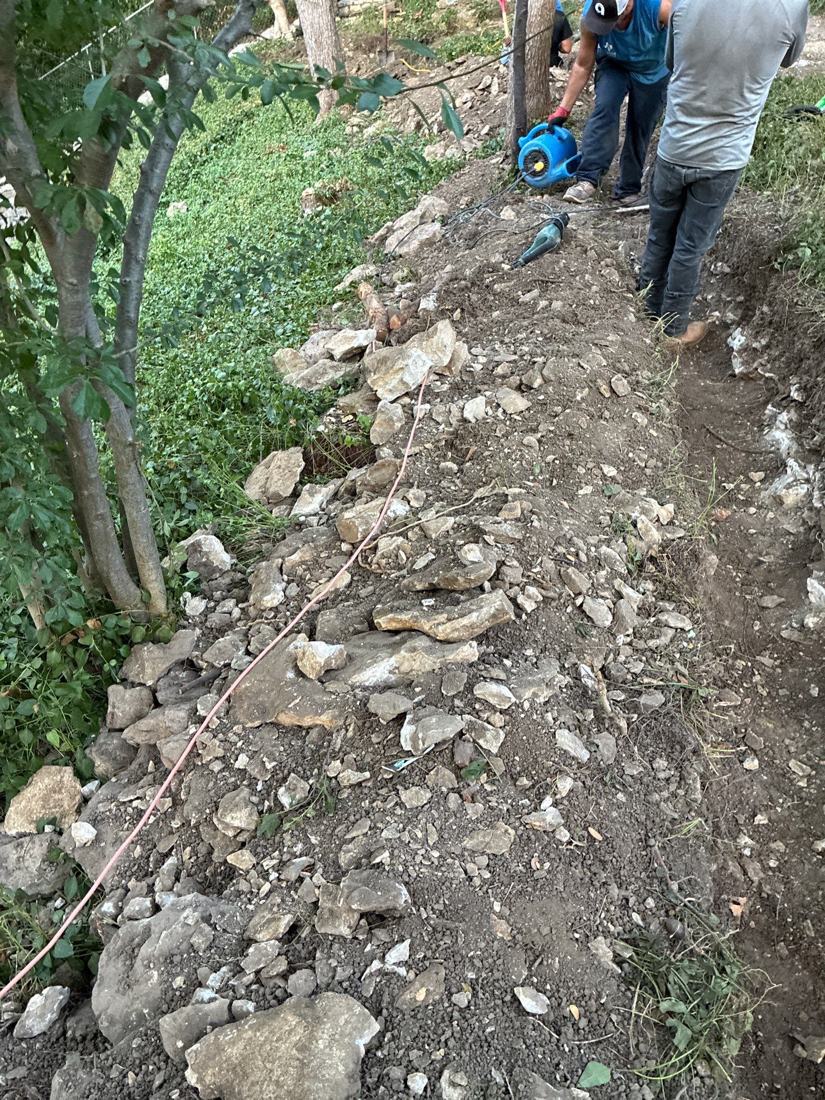
- Soil Conditions clause: rock, dense clay, or roots that make shovel work impractical.
- Piers: per-hole charge, as encountered, hole by hole.
- Drainage: per linear foot.
- Vehicle: the change order process, explained BEFORE the dig.
- ServiceTitan flags known rocky areas. When it does, the expectation conversation is mandatory, up front.
Change Orders Are An
Expectations Product
That's not a reason to stay quiet. It's the reason to talk.
A change order explained at the kitchen table is professionalism. The same change order explained at the invoice is a betrayal.
Tell the room about a change order that went sideways on you. What exact sentence, said before the shovel hit dirt, would have changed it?
Water is the #1 cause of
foundation problems.
The Solution Selector
| Problem | System | Key requirement |
|---|---|---|
| Saturated soil / subsurface water | French drain (gravel trench + perforated pipe) | Filter fabric wrap to prevent clogging; 18"-24" typical depth |
| Heavy surface volume, gutter tie-ins | Solid surface drains | Smooth interior pipe, consistent slope |
| Both saturation AND runoff | Dual drain | Perforated pipe under solid lines, shared emitters |
| Pooling on driveways / patios / walkways | Channel grate drain | Connect to solid lines with gravity slope |
| No gravity: low-lying, negative slope, wet crawl space | Sump pump system | 3/4 HP standard, 2" discharge, check valve |
| Large yard, gradual slope, underground impractical | Swale (concrete or soil) | Concrete for high flow/erosion; soil is cheaper, needs maintenance |
The 1-per-10 Rule
- Locate the discharge (emitter or curb breakout) first. It dictates trench depth for everything behind it.
- Laser level or string line, marking 1" per 10' of rise back toward the collection box.
- Gravity never calls in sick. Design for it and the system works for decades.
Pipe Sizes: Three Numbers
4" · The standard
Most residential projects, normal runoff volumes.
6" · The heavy
Long runs with multiple connections, big roof areas, commercial flow.
2" · One job only
Sump pump discharge lines. Nothing else. Ever.
When To Sell Drainage
Pooling
Standing water within 5-10 feet of the foundation, or a yard that stays wet for days after rain.
Intrusion
Water in the crawl space or basement. Foul smells or mold under pier and beam homes.
Erosion
Soil washing out near the perimeter, gutter overflow trenching the beds, persistent damp landscaping.
Think about your last five closed jobs. How many had a drainage problem you saw and didn't sell? What was the sentence you didn't say?
Expectations set before the
shovel are service.
After, they're excuses.
Why Choose Us
Prepping For Work: Who Does What
The customer
Home during repair · removes wall items · removes flooring · waters the perimeter before work · keeps the work area accessible · kennels pets
The process
Utilities marked through Texas 811 · scope and conditions reviewed · extra depth = extra charge, explained · no T-beams (GL Hunt policy) · soil, rock, or roots may cost more · hidden issues follow the change order process
During And After: Tell The Truth Early
- Cracks may remain, and may even worsen before they settle. Doors and windows may stick.
- Sinkholes may form. Concrete breakouts stay visible. Interior dust happens: cover electronics and valuables.
- 60-day minimum before patching or repairing interior cracks. Maintain the watering program.
Money, Plumbing, Warranty
Payments
25% deposit to schedule · balance due day of job · under-24-hour notice = cancellation/reschedule fee · late payments 1.5% of balance
Plumbing
Customer is responsible for plumbing damage. A PASSING post-repair hydrostatic test is required for warranty.
Warranty
Active after final payment + passing plumbing test · transferable with conditions · void if unpaid or altered.
The house didn't
break last week.
The Shoebox And The Dollhouse
What we fix, and how fast
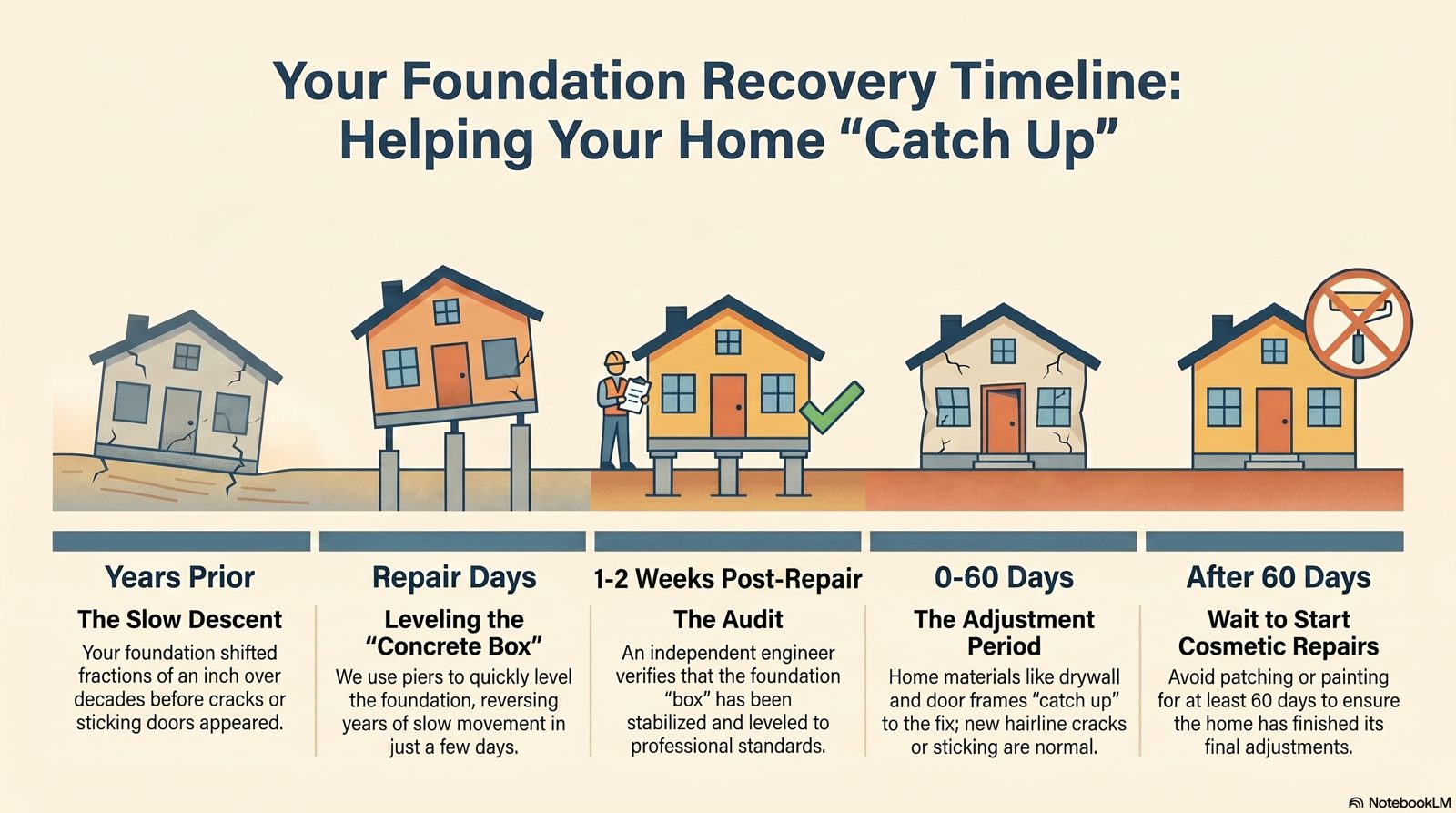
The foundation is the concrete box the home sits on. We level THE BOX with piers, reversing years of slow drift in a couple of days. That speed is the whole point.
What happens next
Everything on top: brick, drywall, trim, tile, door frames, spent YEARS adjusting to the fall. Now they adjust back, on their own schedule, not ours.
The 60-Day Window
- Normal: new hairline cracks. A door that worked on lift day sticking again at week two or three. Old cracks shifting slightly before they settle.
- The ask: no patching, painting, or remodeling for at least 60 days. We'd be asking them to patch a wall that's still moving.
- The posture: keep a list, call us, we review it together once the home settles. We'd rather walk them through it than have them wonder.
The Recovery Timeline
The Engineer Grades The Box
What the report IS
A third-party engineer re-measures the exact points measured before and after our repair and answers one narrow question: did GL Hunt stabilize or lift this foundation to standard? You can't fake a level reading.
What it is NOT
A prediction of how drywall, doors, and windows behave over the next two months. A clean report and a sticking door are answers to two different questions. Both can be true.
Now It's Yours
Your focus areas
The sections you scored under 80% are your personal study list. The documents are on the training tab. Camp is the review; the reps are on you.
Your reforecast
You signed an H2 number. Not a hope, a commitment. Your Monday scorecard now has a destination.
Your three actions
SMART, dated, and on file. Your manager has a copy. In 60 days we check receipts, not intentions.
Same exam, same standard, second attempt on file. The gap between attempt one and attempt two is the measure of this week.